Tile or stone
Tile or stone
Tile or stone forms the finished wearing surface. It sheds most surface water, but joints and junctions are where moisture can enter below.
Where protection sits
The membrane beneath the finish prevents that moisture from reaching the structure.
The finish sheds water. The membrane protects the structure.
Adhesive
Adhesive
Adhesive bonds the tile or stone to the waterproofing membrane. Voids in the adhesive bed are where water and soap residue can collect. Repeated showering can prevent these pockets from fully drying, contributing to musty odours. More critically, retained water exploits defects in the waterproofing.
How coverage is achieved
Suitable trowel selection, directional combing and fully collapsed adhesive ridges establish coverage—not excessive build-up beneath the finish.
Coverage controls both the bond and the space water can occupy.
Waterproofing
Waterproofing
Waterproofing is not one universal product. Membrane types differ in adhesion, flexibility, reinforcement and their ability to accommodate movement, heat and sustained wet exposure. The system must suit the substrate and conditions of the area; being waterproof does not make every membrane suitable for every assembly.
What governs selection
Waterproofing membranes suited to standard wet areas are not automatically suitable over a heated floor. Here, the membrane must accommodate repeated thermal movement.
The conditions define the membrane.
Underfloor heating
Underfloor heating
Underfloor heating can continue through wet-area floors, including showers, when the cable is correctly embedded within a membrane system that can withstand heat, moisture and movement.
How continuity is maintained
The cable is fully embedded and protected before the membrane is applied continuously across the complete heated floor.
Heating may enter the wet zone. The waterproof plane must remain continuous.
Substrate
Substrate
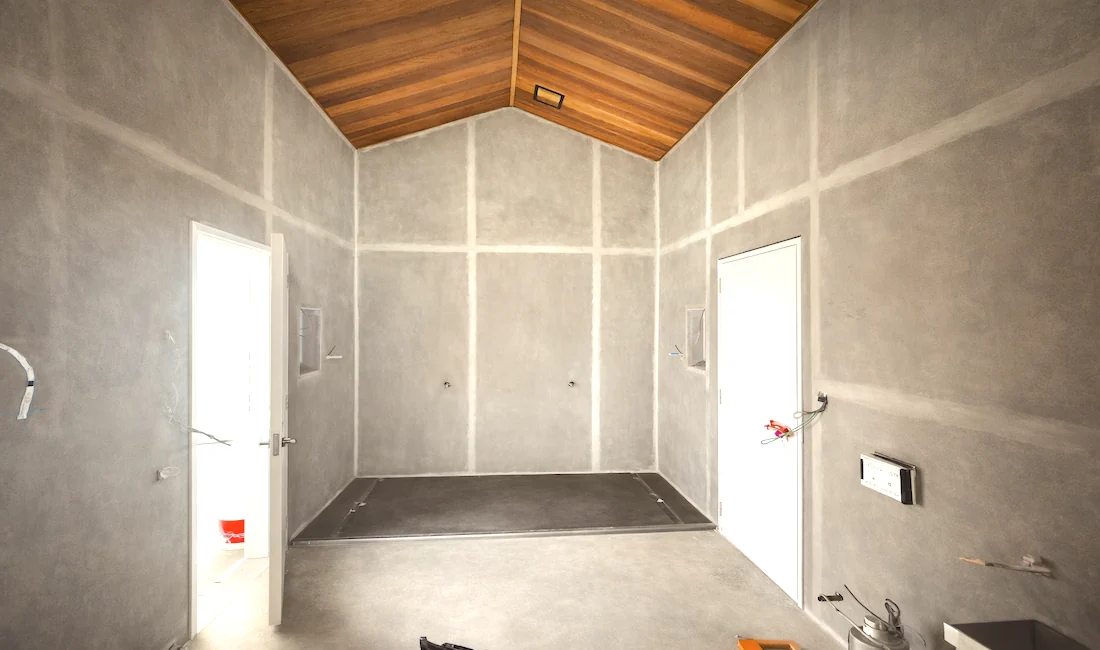
Substrates are not interchangeable. Concrete, screed, cement board and timber each present different movement, moisture and bonding conditions.
What must be established
The substrate type and condition determine the preparation, priming, reinforcement and movement treatment required before waterproofing begins.
Unmanaged movement below becomes failure above.