Assessment
Substrate discipline 01
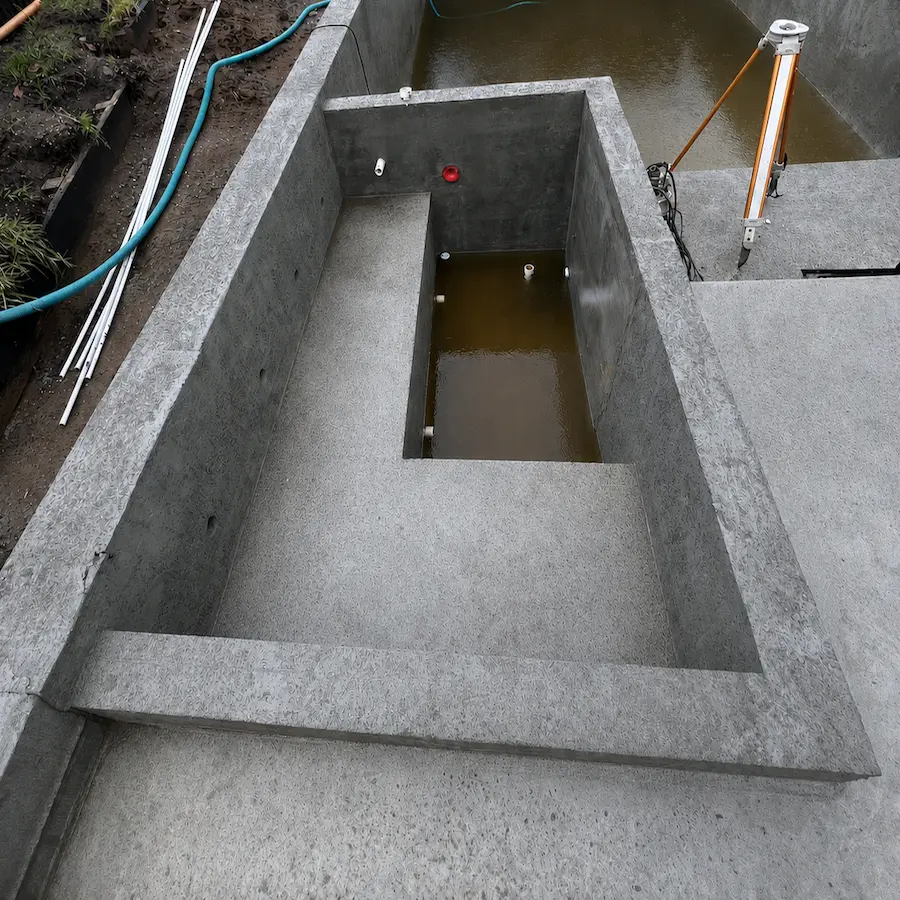
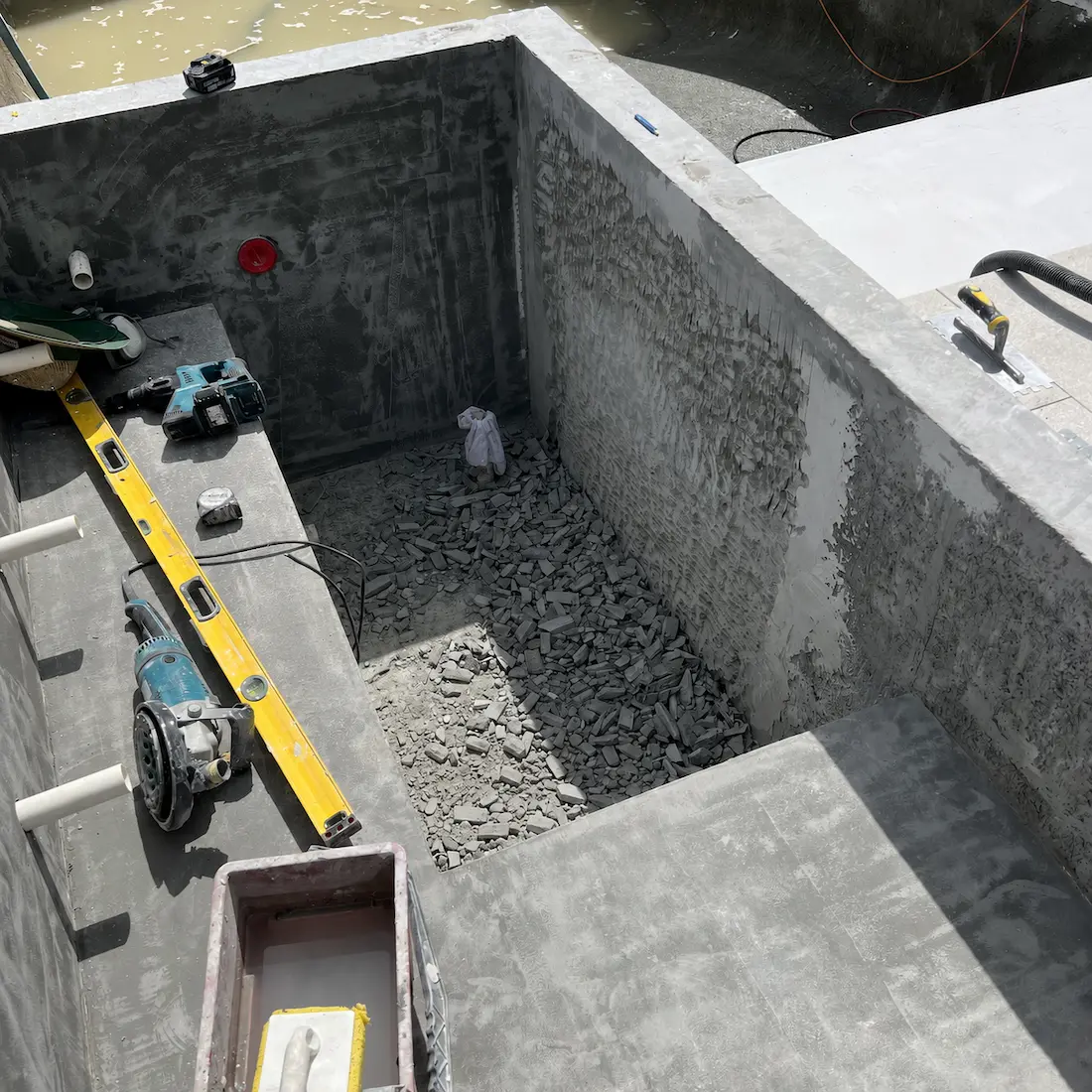
The shell was formed. The geometry was not.
Assessment measures the substrate against the geometry, levels and tolerances the selected finish requires. It establishes what is sound, what must be removed and the exact extent of correction.
Shown here
Warping in the spa shell would carry through the finished planes, radii and mosaic alignment. High areas were removed; low areas were rebuilt by screeding.
Correction begins with measured deviation.
Assessment · deviation · removal · correction
Falls + screeding
Substrate discipline 02
Forming floors & falls
Levelling compound or cement screed establishes the floor plane, finished height and relationship to adjoining surfaces. Where water must drain, the same substrate is formed to a deliberate fall.
Shown here
The entire floor was screeded so the tile would finish level with the adjoining timber, while the shower base was formed independently to fall to the drain.
Level where surfaces meet. Fall where water must move.
Plane · drainage · thresholds · finished heights
Mechanical preparation
Substrate discipline 03
Expose material worth bonding to
Adhesive strength is irrelevant when the surface beneath it is weak. Laitance, friable material, old coatings and contamination can leave the installation bonded to a layer already capable of separating.
How it is controlled
Grind or mechanically abrade until sound material is exposed, then remove residue and dust before the next layer is applied.
The next layer must bond to the substrate—not to what is loosely attached to it.
Grinding · laitance removal · cleaning · bond
Radius formation
Substrate discipline 04
A circle cannot be tiled into existence
Mosaic follows the form beneath it. A true circular finish requires a fixed centre, consistent radii and level horizontal planes before any surface layer is applied.
Shown here
The spa was screeded from fixed centre points, correcting the shell and levelling each horizontal plane before waterproofing and mosaic.
The circle is formed before it is finished.
Centre · radius · plane · perimeter
Whole-shell correction
Substrate discipline 05
Correct the shell as one field
A pool shell cannot be corrected as a collection of isolated patches. Wall planes, steps, waterline and floor transitions must all return to the same fixed levels and reference lines.
Shown here
Render is mixed to a consistent working profile, placed across each connected surface and screeded back to established datums throughout the shell.
Every local correction must remain true to the whole.
Datums · planes · levels · transitions
Material offsets
Substrate discipline 06
The seamless finish begins in the shell
Stone, mosaic and pool plaster build to different depths. If the substrate remains continuous behind them, their finished faces will not be.
Shown here
The shell was stepped and screeded to accommodate each material build-up, allowing stone, mosaic and pool plaster to meet on one continuous finished line.
Different build-ups. One finished plane.
Stone · mosaic · plaster · finished alignment
Wall plane correction
Substrate discipline 07
Create the plane before the pattern
Tile records the wall it is given. Bows, twist, inconsistent corners and surfaces out of plumb become wandering joints, variable cuts and disturbed reflections.
How it is controlled
Read the wall with a level and straightedge, mark each deviation, then render or fill until the surface is true, the wall is plumb and every corner meets the tolerance of the selected finish.
The pattern will record every deviation left in the wall.
Plane · plumb · corners · tolerance